
Nate
If You Can Squat Well, You Can Age Well: A Longevity Movement Guide
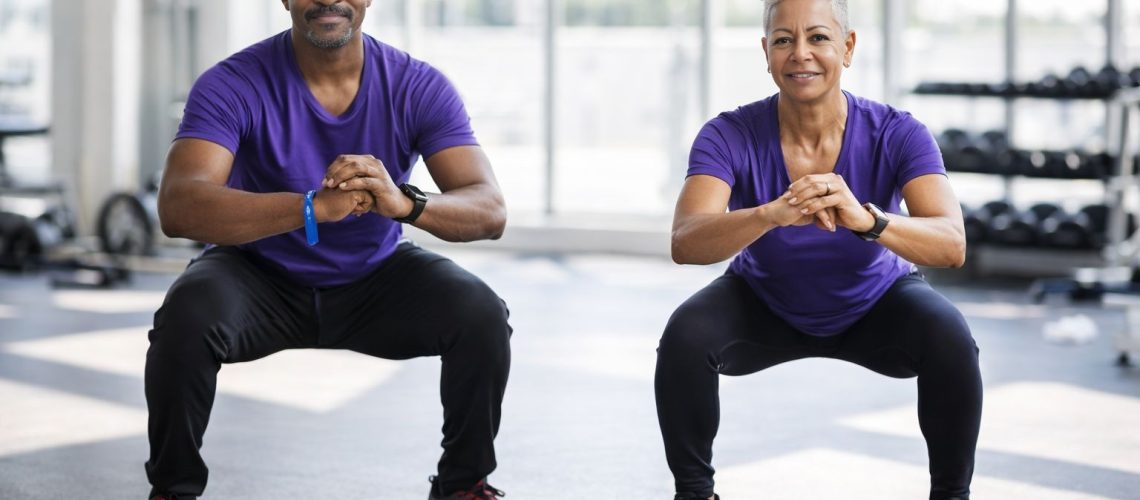
Human movement reveals a great deal about long-term health.
Among all fundamental movements, one stands out as a powerful indicator of strength, mobility, and resilience:
The Squat.
The ability to squat well requires the integration of multiple systems in the body:
lower-body strength
joint mobility
balance
coordination
neuromuscular control
When these systems function well together, the body moves efficiently and remains capable across decades.
This is why movement specialists often say:
“If you can squat well, you can age well.”
Within the Ageless Workout Method, the squat is considered a foundational movement for building lifelong strength, structural stability, and independence.

What a Healthy Squat Reveals About Your Body
A proper squat requires coordination between several body regions. When someone performs a stable squat, it demonstrates:
What Your Joints Actually Need After 50
Joint-friendly workouts for over 50 tie directly to proactive aging and longevity. Focus on these essentials to keep moving freely.
Hip Mobility
The hips must move through a controlled range of motion while maintaining stability. Restricted hips often cause compensations such as forward leaning or knee strain.
Ankle Mobility
Limited ankle mobility is one of the most common barriers to a deep squat. Without sufficient ankle dorsiflexion, the body struggles to maintain balance during the movement.
Core Stability
The spine must remain stable while the lower body moves. Strong core muscles help distribute load safely across the body.
Leg Strength
The quadriceps, glutes, and hamstrings work together to control both the descent and ascent of the squat. This strength supports everyday movement and protects the joints.
Why Squat Strength Becomes More Important After 40
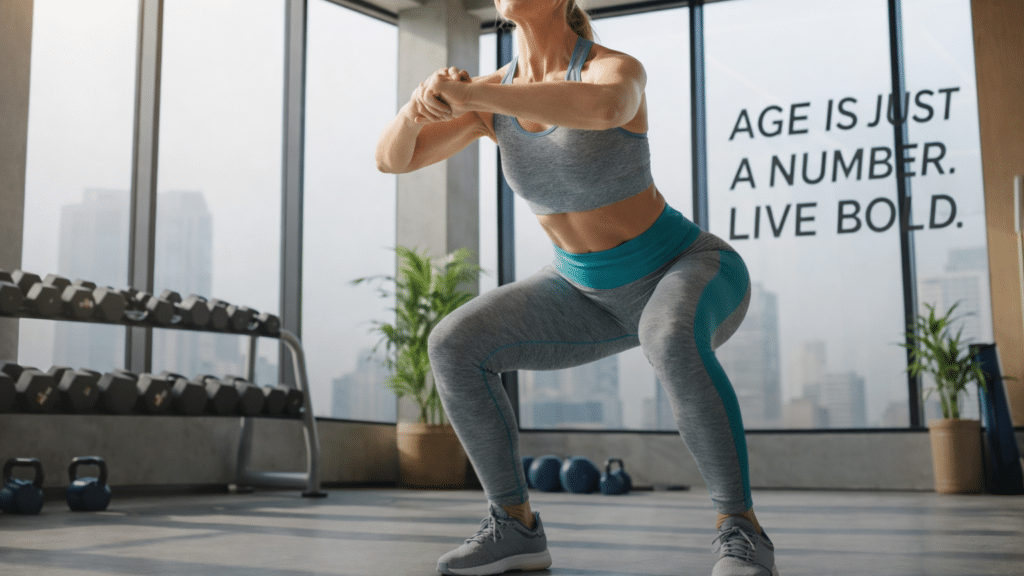
Beginning in midlife, several physiological changes occur:
gradual muscle loss (sarcopenia)
reduced bone density stimulus
slower metabolic rate
decreased joint elasticity
These changes make lower-body strength increasingly important.
Strong legs support:
balance and fall prevention
metabolic health
joint stability
independence in later years
The Ageless Workout Method addresses these changes through progressive strength training and mobility work.
Rather than chasing intensity, the focus is on building durable movement capacity.
The Longevity Connection: Lower Body Strength and Aging
Multiple studies in longevity research highlight a clear relationship:
Lower-body strength is strongly associated with healthy aging.
Individuals who maintain strong legs tend to experience:
better mobility
reduced fall risk
improved cardiovascular health
greater independence in older age
The squat serves as a practical way to train and measure this strength.
It is both an exercise and an assessment tool.
The Squat Longevity Assessment
To evaluate squat ability, a simple movement test can be used. This assessment helps determine how well your body performs this foundational movement.
The 30-Second Squat Test
- Stand with feet shoulder-width apart
- Extend your arms forward for balance
- Lower into a squat as if sitting in a chair
- Stand back up
- Repeat for 30 seconds with controlled movement
Observe the following:
- depth of the squat
- balance stability
- knee alignment
- ability to maintain upright posture
These observations provide insight into strength and mobility.
A Long-Term Perspective
Aging does not mean losing physical capability.
It means adapting training strategies to support long-term resilience. Maintaining a strong squat contributes to:
- independence
- injury prevention
- mobility across decades
When the body can squat well, it demonstrates that the systems responsible for movement are functioning together effectively.
This is why the statement remains true:
“If you can squat well, you can age well.”